
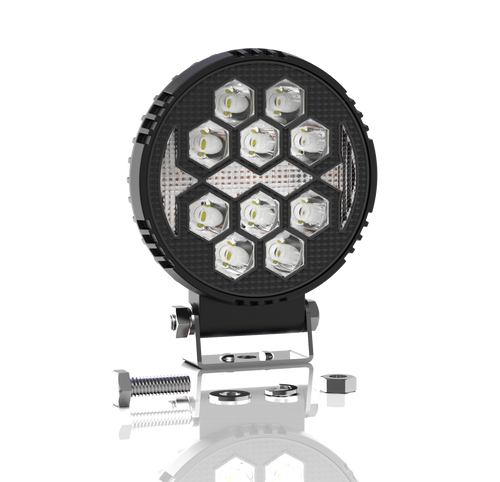
Purchasing LED driving lights involves evaluating a set of technical specifications that can be difficult to interpret without a clear framework. The consequences of selecting uncertified or inadequately specified lights range from premature product failure to legal non-compliance and, in professional or emergency service applications, genuine operational risk. Industry data suggests that a significant proportion of lower-priced LED vehicle lighting available in the UK market carries incomplete or self-declared certification rather than independent third-party verification. Identifying the best led driving lights requires understanding exactly what each certification means, why it matters, and how to verify that a product genuinely holds what it claims.
Understanding IP Ratings for LED Driving Lights
Ingress protection ratings are defined by the International Electrotechnical Commission under standard IEC 60529. Each IP rating consists of two digits: the first indicating protection against solid particle ingress, the second indicating protection against water ingress.
For LED driving lights, the relevant ratings are:
IP67: The first digit (6) confirms complete dust-tight construction. The second digit (7) confirms protection against temporary water immersion to one metre depth for up to 30 minutes. Suitable for standard road use, light off-road, and most consumer vehicle applications.
IP68: Extends IP67 water protection to sustained submersion at depths greater than one metre. The exact depth and duration are specified and independently tested per product. Suitable for vehicles that may experience water crossings or prolonged exposure to wet conditions.
IP69K: The most demanding standard, confirming resistance to high-pressure, high-temperature water jets at up to 100 bar and 80°C from all directions. Mandatory for agricultural machinery, emergency vehicles, and industrial equipment subject to regular power washing.
CE Conformity: What It Means and Why It Matters
CE marking on a LED driving light confirms that the product complies with all applicable EU directives that cover its product category. For LED vehicle lighting, the most relevant directives include the Low Voltage Directive (LVD) and the Electromagnetic Compatibility Directive (EMCD).
CE marking is a legal requirement for products placed on the EU market and is recognised in the UK under the UKCA framework with equivalent requirements. Products bearing CE marks without genuine compliance documentation—a practice sometimes referred to as fraudulent CE marking—are unfortunately present in the market, particularly among lower-cost imports.
Buyers should request the Declaration of Conformity document from suppliers to confirm CE compliance is genuine and complete.
RoHS Compliance and Its Relevance to Vehicle Lighting
The Restriction of Hazardous Substances Directive (RoHS) restricts the use of specific hazardous materials in electrical and electronic equipment, including lead, mercury, cadmium, hexavalent chromium, and certain flame retardants.
RoHS compliance is a legal requirement for products placed on the EU market and is mandatory under UK regulations. For public sector and government procurement, RoHS compliance documentation is frequently a contractual requirement. Buyers should confirm RoHS compliance documentation is available before purchasing LED driving lights for fleet or institutional use.
How to Verify LED Driving Light Certifications
The most reliable approach to verifying LED driving light certification is to request the following documentation directly from the supplier before purchase:
IP test reports from an accredited independent testing laboratory, referenced to IEC 60529
EMC test reports from an accredited laboratory, referenced to the applicable directive
CE Declaration of Conformity covering all applicable directives
RoHS compliance statement or test report
Reputable LED vehicle lighting suppliers will have this documentation available for every product in their range and will provide it promptly on request. Reluctance or inability to provide independent test documentation is a clear indicator that the certification claims may not be genuine.
Choosing a supplier with a demonstrated track record across professional markets—including emergency services and defence procurement, where documentation requirements are most stringent—provides additional assurance that the products and their certifications meet genuine professional standards.
